Cobalt Credits: Financing Real Improvements at Artisanal Mine Sites
For the artisanal cobalt mining sector to comply with international standards and ensure that women and men working at the mine sites operate under safe and dignified working conditions, significant investment is needed.
Since the first credits were purchased in August 2023, Cobalt Credits have moved from concept to a working mechanism channelling downstream investment directly into safer, more dignified conditions at artisanal mine sites in the Democratic Republic of Congo.
Cobalt Credits are a ‘book and claim’ system that lets downstream companies financially contribute to improvements at artisanal mine sites committed to professionalising their operations. Each credit represents one tonne of cobalt produced by a responsible local partner cooperative. The model was developed by The Impact Facility (TIF), together with Fairphone and other members of the Fair Cobalt Alliance, through a Taskforce for Supply Chain Integration.
The impact so far
Credit sales fund mine improvements prioritised by a Fund Allocation Committee (FAC) of elected worker representatives. To date, this has delivered concrete results at the Kamilombe mine site, operated by the CMDS cooperative:
- 1. Underground air circulation. 13 dynamos installed for USD 15,500, improving ventilation for 5,220 underground workers across 129 pits.
- 2. Dignity for women washers. A dedicated changing room built for USD 12,307, serving 200 women working on site.
- 3. Waste management. A tricycle provided for on-site waste collection at USD 4,550, benefiting the roughly 6,000 miners at Kamilombe.
- 4. Protective equipment. 402 pairs of gloves purchased for USD 2,000 for the 200 women washers, reducing exposure to waterborne disease.
- 5. Safety Ropes. 5,000 meters of safety ropes purchased to help haul people and material in and out of the ground.
These projects are identified and prioritised by the workers themselves.
A growing buyer base
Fairphone was the first to purchase credits, launching alongside the Fairphone 5 in August 2023 and continuing to buy credits each year to match its cobalt consumption. The scheme has since expanded to additional buyers and to a second mineral: in 2025, Fairphone and Exped purchased both cobalt and copper credits, with further downstream companies now in active conversation.
How Cobalt Credits work
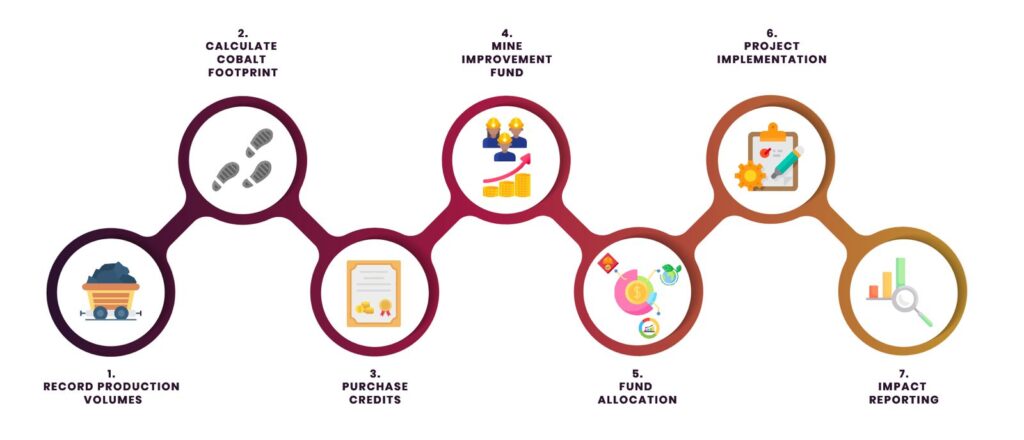
Cobalt Credits are issued based on actual cobalt production volumes monitored at specific FCA partner mine sites, such as the Kamilombe mine site, which is operated by the local cooperative CMDS.
Downstream companies in the cobalt supply chain can determine their cobalt footprint – the amount of cobalt used in their products – and subsequently decide how many Cobalt Credits they wish to acquire. Based on this, they are allowed to make certain claims around how their cobalt use contributes to improving conditions in artisanal and small-scale mining production.
Companies purchase Cobalt Credits, each representing one tonne of cobalt produced by a responsible local partner cooperative, like CMDS.
The Fair Cobalt Alliance, through The Impact Facility, collaborates with a local Fund Allocation Committee, comprising representatives of different groups of workers active at the mine site, to invest the funds generated from Cobalt Credit purchases. These funds are directed towards projects addressing critical improvement areas, including Health and Safety, Child Rights Protection, Cooperative Governance, and Environmental Protection.
Participating companies receive detailed reports showcasing the tangible social, environmental, and economic improvements taking place within the supported mining cooperative and its community. This transparency ensures that companies can witness the impact of their investments firsthand.
Why Companies Should Support Cobalt Credits
Every investment goes toward transforming conditions at the source, with no additional traceability or logistics costs.
Credits let companies act at the very start of their supply chain, commensurate with their cobalt footprint, with reporting that evidences the result.
Supporting responsible production does not require changing suppliers or restructuring sourcing.
Credits address latent ASM risks that direct physical offtake cannot easily reach, in line with OECD due diligence expectations.
Help shape the framework: open consultation
Cobalt Credits are now informing a broader, mineral-agnostic framework for book-and-claim credit schemes that can be adapted across different minerals and regions. The draft is open for public consultation before version 1.0 is published in September 2026, and your input will shape how it works in practice.
Kick-off webinar held on 24 June 2026
(with simultaneous interpretation in English, French, and Spanish).
Public Consultation open: 24 June 2026 and closes 6 August 2026.
Version 1.0 publication: September 2026.
Read the Draft Framework for Book-and-Claim Credit Schemes and take part in the consultation: